

Clinical insights on energy, focus, resilience and strategic health.
This had my eyebrows lifting to my hairline this week
I was listening to Andrew Huberman’s sponsored segment for Function Health when he explained that testing revealed elevated LDL.
The proposed solution? Nattokinase. And - magic - the LDL came down.
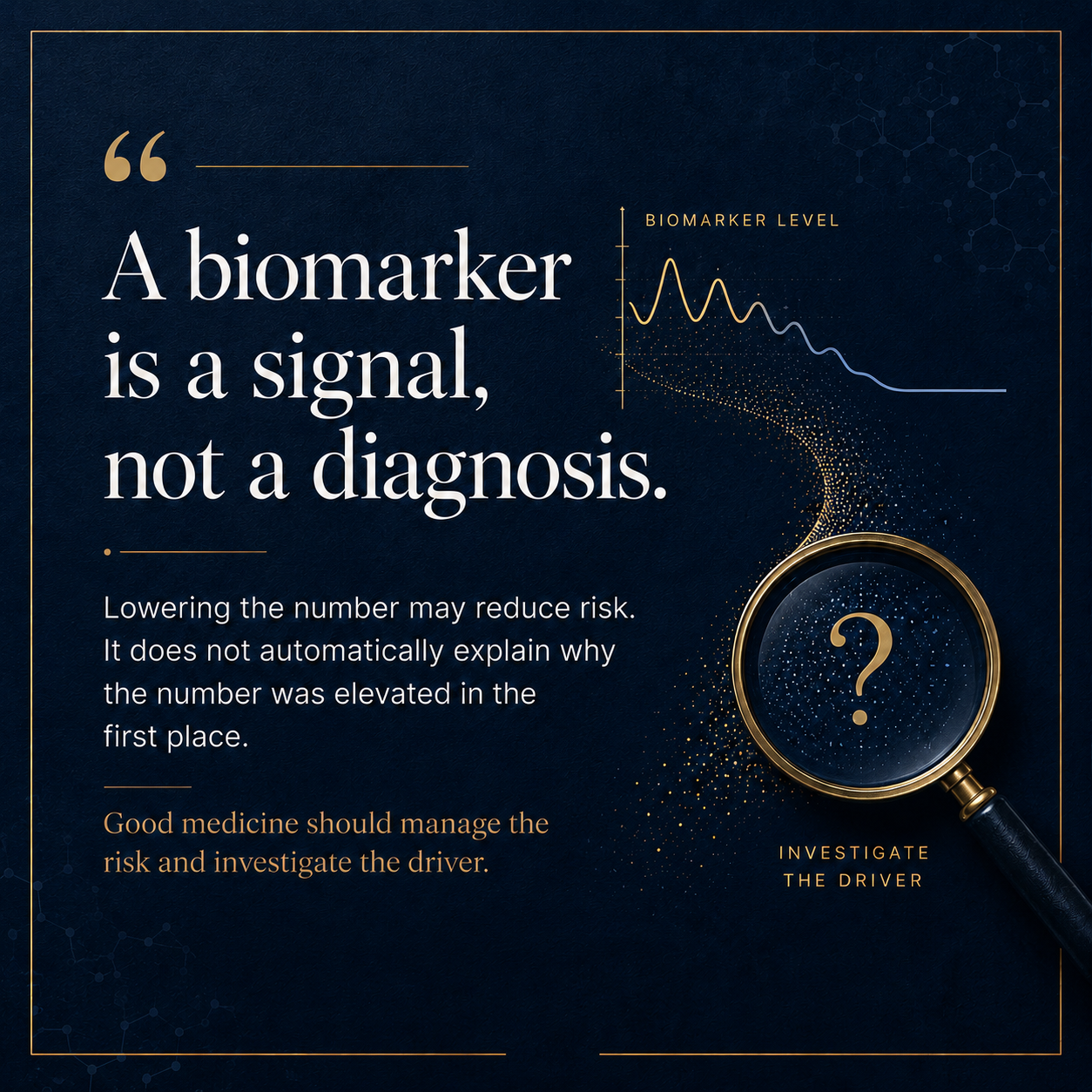
Excellent. Except for one small question: Why was the LDL elevated in the first place?
Reducing a biomarker is not the same as resolving the biological reason it became abnormal. LDL can be influenced by genetics, thyroid function, insulin resistance, liver metabolism, hormonal changes, diet, inflammation and wider metabolic dysfunction. So yes, nattokinase may lower the number. But if it does not address the mechanism producing the elevation, we have not necessarily improved health. We may simply have made the laboratory report look 'prettier'.

You can function extremely well while your biology is already moving in the wrong direction.
I was recently interviewed by Bold Journey about the work behind The Nutrition Clinic, the experiences that shaped my approach to health, and why I believe the future of healthcare needs to become far more precise.
One of the central themes of the conversation is something I see repeatedly in my work:
People can remain highly functional long after their biology has started moving in the wrong direction.
This is particularly relevant for founders, executives and leadership teams.
Someone can still perform, make decisions, lead a company and deliver results while simultaneously dealing with declining energy, disrupted sleep, blood sugar instability, hormonal changes, inflammation, nutrient depletion or chronic physiological stress.
The problem is that these changes rarely arrive with a clear warning sign.
By the time performance is visibly affected, the underlying biological shift may have been developing for years.

When testing just becomes more noise.
Anyone who listens to Andrew Huberman - which admittedly I do from time to time, as he is great at communicating science to the masses - has sat through the sponsored bit where blood tests for heavy metals are framed as a detox compass. To be frank: This sponsored bit is pretty impressive confidence for inaccurate science. And it hurts my soul.
As someone who routinely screens and treats clients for environmental toxins for over a decade, this is just not right.
Blood heavy metals reflect what you ate yesterday. Sushi today, panic tomorrow - according to blood test. Skip fish for a few days, miracle recovery - also according to blood test. That’s simply temporary exposure and has nothing to do with toxic body burden.

Obesity is not a calorie problem, it’s a regulation problem
Most conversations about weight are still stuck in calories. And at this point, it’s limiting how we think about the problem entirely. Because weight is not primarily about discipline. It’s about regulation. Last month, I was invited to sit down with senior leadership at Danone to explore novel ways of addressing our obesity pandemic. I chose to explore how to address the obesity pandemic from a regulation angle - what I like to call: satiety engineering. We went over the different phenotypes driving weight gain. Because obesity is merely the symptom of a broken system. If we want to change the trajectory we need to understand the system we are trying to fix. What actually drives appetite, energy, and fat storage? This may seem obvious in writing, yet we are not doing it in reality. Rather we are trying to override the system - white-knuckle it through - and it's not working very well. You cannot willpower your way out of a broken biology. That's just not how biochemistry works.