This had my eyebrows lifting to my hairline this week
I was listening to Andrew Huberman’s sponsored segment for Function Health when he explained that testing revealed elevated LDL.
The proposed solution? Nattokinase. And - magic - the LDL came down.
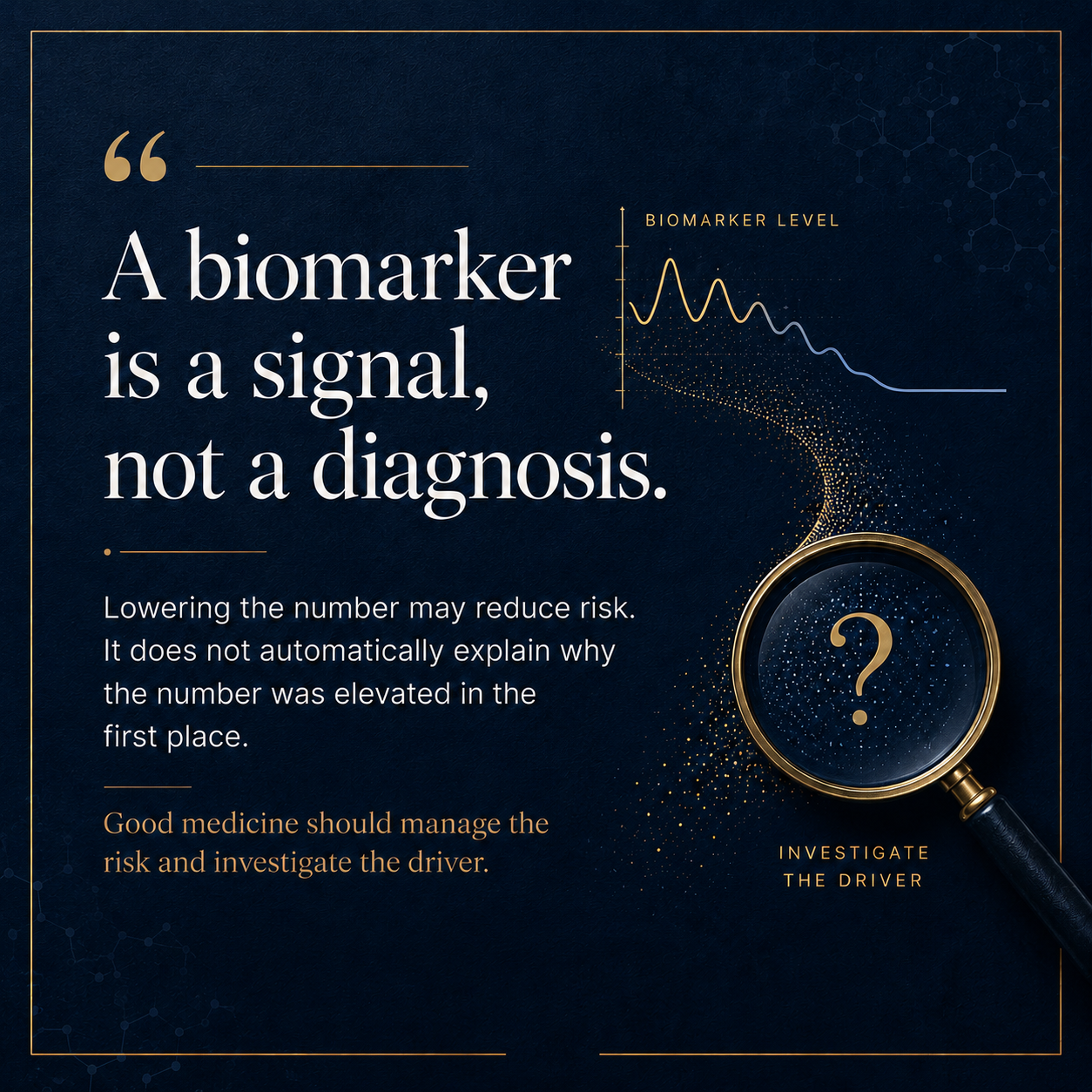
Excellent. Except for one small question: Why was the LDL elevated in the first place?
Reducing a biomarker is not the same as resolving the biological reason it became abnormal. LDL can be influenced by genetics, thyroid function, insulin resistance, liver metabolism, hormonal changes, diet, inflammation and wider metabolic dysfunction. So yes, nattokinase may lower the number. But if it does not address the mechanism producing the elevation, we have not necessarily improved health. We may simply have made the laboratory report look 'prettier'.
Cholesterol participates in the body’s response to inflammation. Therefore, lowering LDL without investigating why it is elevated may improve one risk marker while leaving the wider biological dysfunction unresolved.
This is where modern health optimisation can become dangerously simplistic:
Test something.
Find a red number.
Sell something that turns it green.
Declare victory.
Supplements can suppress biomarkers just as medication can. “Natural” does not automatically mean causal, appropriate or harmless.
There are certainly situations where lowering LDL is clinically necessary. But treatment should be based on the individual’s total cardiovascular risk and underlying physiology - not on the assumption that every elevated marker needs to be immediately pushed downward.
A biomarker is a SIGNAL. It is not the disease.
And manipulating the signal without understanding the system is not precision health: It is cosmetic biochemistry akin to botox and fillers.
This is also why practitioners need to respect scope of practice and refer out when interpretation moves beyond their clinical expertise. Because when testing becomes a supplement sales funnel rather than an investigation, it can interfere significantly with the treatment process.
Sometimes the most intelligent response to an abnormal result is not: “What can we take to lower it?”
It is: “What is the body trying to tell us?”